
A deep dive into the language, food, history, and one very specific photo that hits differently once you’ve seen the film.
There’s a scene early in The King’s Warden that I keep coming back to.
Hong-wi gets served breakfast. The village chief, Heung-do, launches into a whole speech about how he personally went down to the river at the crack of dawn and caught the freshwater snails himself —
And the deposed king just goes:
아니이이~ Ani-e-e
If you watched this with subtitles, you probably got something like “No.” And technically, sure. But there’s an entire world living inside that one syllable that no subtitle could carry — and it’s the world this post is about.
Layer 1: The Grammar of a King — “Na” vs “Jeo”
Two Words for “I”
Let me start with something small. So small it almost disappears.
If you’ve spent any time learning Korean, or even just watching K-dramas closely, you know that Korean has levels. Speech levels that shift depending on who you’re talking to, what your relationship is, and — crucially — how you refer to yourself.
There are two ways to say “I” in Korean. Both translate to the same single English letter. That’s the gap right there.
저 (jeo) — the humble form. You use it when you’re lowering yourself in front of someone. It signals deference, respect, a kind of social bowing.
나 (na) — the neutral form. Not rude — just level. The form you use with peers, with equals, with people you don’t feel the need to position yourself beneath.
The Scene That Wrecked Me
There’s a scene where Han Myeong-hoe comes to see Hong-wi.
🔗 This is the man who wrote the kill list. The man who engineered the coup, positioned the troops, and has been running Joseon from the shadows for years. He’s come to see a teenage boy who’s been refusing to eat — this quiet, heartbreaking, stubborn hunger strike — to politely threaten him into compliance.
Just outside, in the distance, loyalists are being tortured. Their screams bleeding through the air.
And in the middle of all of that, Hong-wi turns and asks:
“나는 이제 어디로 갑니까?” (“Na-neun i-je eo-di-ro gam-ni-kka?)
“Where am I going now?”
갑니까 (gam-ni-kka?) — that’s the formal verb ending. He’s technically speaking up to Han Myeong-hoe, giving him the grammatical respect that power demands.
But he calls himself 나(na). Not 저(jeo).
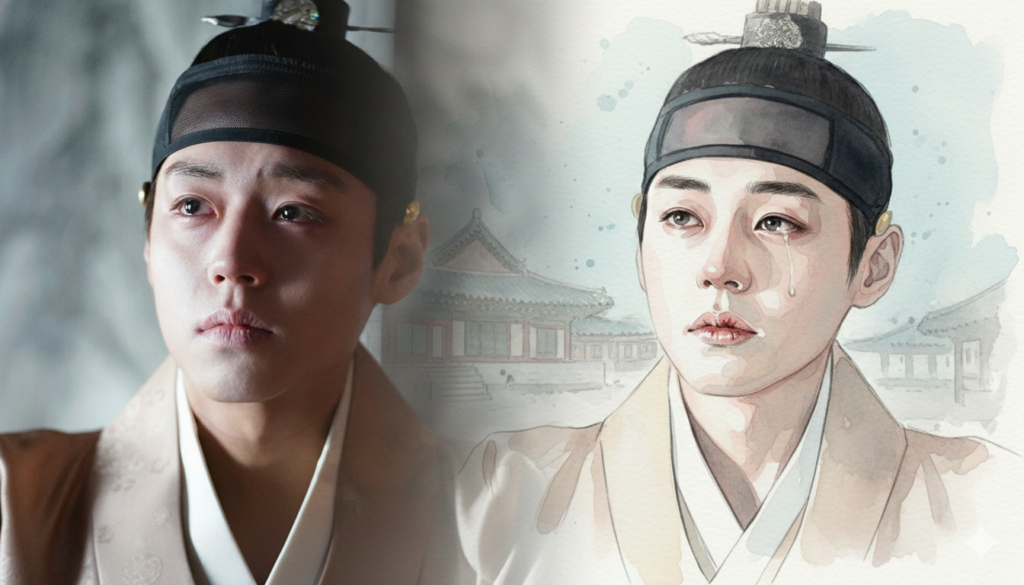
His eyes are doing that thing — trembling, frightened, completely visible fear. He’s been stripped of his title, his court, everyone who ever protected him.
And yet. The grammar of lowering himself — nobody ever needed to teach it. And he never needed to learn it.
Not because he’s consciously refusing to bow. But because he was born a king, raised a king, and somewhere along the way, that grammar simply never existed in his world.
Park Ji-hoon doesn’t announce this. Doesn’t underline it. Just lets it sit there, naturally, the way it would for someone who has genuinely never been anyone other than a king.
Layer 2: 먹다 (Meokda) — The Korean Word That Lives in Everything
Why Korea Invented Muk-bang
Korea is the birthplace of mukbang. Eating broadcasts. The genre where someone sits in front of a camera and eats — often enormous amounts, often alone — while viewers watch and find it deeply comforting.
That didn’t come from nowhere.
In Korean, the verb 먹다 (meokda) means to eat. But eating in Korean isn’t limited to food — it’s embedded in the language at a level that reveals something deeper about the culture itself.
The Many Things Koreans “Eat”
You eat age — 나이를 먹다 (na-i-reul meokda). Getting older isn’t counted or measured — it’s consumed.
You eat a decision — 마음을 먹다 (ma-eum-eul meokda). Making up your mind is a physical act. You swallow your resolve.
A plan that fails doesn’t just fail — 안 먹힌다 (an meok-hinda). It doesn’t eat. It didn’t go down.
먹다 (meokda) is woven into the language at a foundational level — which tells you that eating isn’t just sustenance in Korean culture. It’s absorption. It’s letting something in. It’s how connection is made, maintained, and measured.
Jeong — The Word English Has No Home For
If you’ve spent any time with Korean dramas, you’ve probably heard the word 정 (jeong) float by at some point.
It’s often translated as affection, or attachment, or fondness. None of those words have a home for what it actually means.
Jeong is the feeling that accumulates between people who share time and space — without anyone deciding to let it. It isn’t chosen. It just arrives. One day it’s there, and you find yourself doing things you never planned to do, for someone you never planned to care about.
Affection is too intentional. Fondness is too light. Attachment sounds clinical.
Jeong is a strange emotional mirage — you don’t notice it arriving, and then one day you’d wade into a frozen river at midnight for someone.
How This Plays Out in Gwangcheongol
If you’ve watched Weak Hero, you’ve already seen this dynamic. Our canoe trio — Ji-hoon, Hyun-wook, Hong Kyung — figured each other out over meat at Suho’s part-time job. That’s where it started. Not through a formal moment of friendship — over a shared meal.
And there’s the scene where Seok-dae says to Si-eun: 언제 밥 한번 먹자 (Eon-je bap han-beon meok-ja) — let’s grab a meal sometime.
Those two will never actually eat together. Their worlds don’t cross like that, and they both know it. Seok-dae isn’t making a plan. He’s doing the Korean thing — saying something he can’t say directly: what you did for me mattered, and I don’t have a word for that, so here’s this instead.
That’s what’s happening in Gwangcheongol.
The villagers don’t decide to care for Hong-wi. It just… happens. One bowl at a time. One morning where he asks about their lives and actually listens. Jeong snuck in. It always does.
Funnily enough, in Gwangcheongol, Hong-wi becomes the village idol.
And Heung-do going on about 자기가 직접 잡은 다슬기로 (regarding snails) — before Hong-wi cuts him off with that 아니이이~ (Ani-e-e) — that exchange tells you everything about where they are with each other. Two people, one bowl at a time, finding a way to exist in the same space.
If you ever work with Koreans — or just want to actually connect with them — eat with them. Not coffee. Eat. You’ll understand this film on a level no subtitle gets you to.
Layer 3: What Korean Audiences Already Knew Walking In
A Story Worn Into the Culture
Every Korean who walked into that theater already knew how it ends.
Danjong’s story is so deeply embedded in Korean culture it’s practically folklore — the kind of thing you absorb before you even know you’re absorbing it. It’s in the school textbooks, the historical dramas, the songs. It’s been retold so many times it’s worn into the culture the way a path gets worn into grass.
And they still cried. Worn-down, bone-familiar history — and still, automatic eye moisturizing. The world’s most efficient cure for dry eyes.
International audiences went in not knowing. And then the ending happened.
A subscriber of mine described watching it as “the lips dehydrated as if thirsty from years… thirsty for an escape from this never ending bizarre sadness.” She’d had no idea it was going where it went.
Layer 4: The Photo That Hits Differently After the Film
Before the film came out, there was a photo that circulated on social media.
Park Ji-hoon — not in the blue robes, not in the exile whites, not on the raft — just crouched down by the water. His back to the camera. Playing. Just a small figure by the river, reaching out to touch the surface.
I remember seeing it and thinking: why did they release this one first? Of all the images they had — the dramatic stills, the costume shots, the full cast — why this quiet little figure with his back to us?
Now I know.
Because after you’ve seen the film, you look at that photo again and it’s unbearable.
That small figure by the water. Enjoy it while it lasts.
Because the water comes for him.
Layer 5: What History Did to Everyone Who Was There
600 Years Later — Korea Still Hasn’t Forgiven
After the film came out, the Korean internet responded in the most historically specific way possible.
People lined up at Danjong’s royal tomb, Jangreung, to leave tributes. Cheongnyeongpo — the exile site — saw five times the usual visitors over Lunar New Year. Six hundred years after his death, and Koreans are genuinely, viscerally still not over it.
Han Myeong-hoe: The Prophecy That Waited 17 Years
Han Myeong-hoe died peacefully at 72. Family by his side. Natural causes. He thought he’d beaten fate — and for 17 years, he was right.
Then 1504 arrived. King Yeonsan — absolute tyrant, everyone’s worst nightmare — discovered his mother had been executed. And guess who had voted for it.
Yeonsan’s order: dig up the grave. Open the coffin. Cut off the head.
This is called 부관참시 (bugwanchamsi) — posthumous execution. You die twice.
Folk legends say when they started digging, the sky went dark and the soldiers hesitated. The prophecy wasn’t wrong. It just waited 17 years.
Sejo’s Karma
Sejo — the uncle who took everything — fared no better in the end. His later years were reportedly consumed by severe, relentless skin disease. The records describe something painful and unstoppable — scratching through the night, blood, searching every hot spring and sacred mountain in the country for relief that never fully came. His sons died young. The dynasty he seized so violently didn’t hold the way he planned.
Interestingly, Sejo doesn’t appear on screen in The King’s Warden at all. Director Jang made a deliberate choice to keep him off camera entirely — channeling all that threat through Han Myeong-hoe instead. The villain you feel but never see. Which, honestly, makes the whole thing more terrifying.
Eom Heung-do: The Man History Remembered
Eom Heung-do — the village chief who buried Danjong when everyone else ran — went into hiding. He split his sons up, sending them to different provinces across the country so that if they were found, they wouldn’t all go down together. He lived as a fugitive for 17 years and never saw his hometown again.
But history remembered.
Today, Eom Heung-do is honored as one of Joseon’s most loyal subjects — his name passed down not as a fugitive, but as a man who chose what was right when no one else would. At Jangreung, his memorial sits beneath Danjong’s tomb. Every visitor passes it. Every visitor stops.
A Final Note on Park Ji-hoon
What This Performance Takes Apart
Korean critics — pretty stingy with praise — have been saying things about this performance that you don’t hear very often.
“There are many actors who act well. But actors who convince you through the acting itself — that’s rare.”
I used to carry this assumption, without really examining it, that devastating performances had to come from personal suffering. That the actors who break you were probably broken first. That somewhere in their past was frost so harsh it left a mark — and that mark is what you’re watching on screen.
Park Ji-hoon quietly takes that apart.
He’s likely been loved his whole life — from pretty much every direction. That’s hardly a stretch to imagine. And yet somehow, he finds his way to places on screen that people who have suffered deeply sometimes can’t.
What Asuka Said
A subscriber of mine — Asuka, who has become something of a co-creator and inspiration booster of this channel — described him as unusually elusive. Reclusive, even. Someone with a dead serious side that all the iconic aegyo never quite cancels out. The way he quietly removes what doesn’t belong in his life — no drama, no announcement — that, she said, confirmed it for her.
And also — genuinely, utterly adorable. Which somehow makes all of the above more interesting, not less.
What I’m Hoping For Next
I don’t know what he does next. But I know I’ll be watching.
And whatever it is — I hope it’s dark. I hope it’s heavy. I hope it asks things of him that even he didn’t know he could give.
Because after The King’s Warden?
I think he can.
If you want to go deeper on Han Myeong-hoe — the man mentioned more times in the Joseon royal annals than most actual kings — 🔗I have a whole video on that.
The costume breakdown — every layer of what Danjong wears and why it matters — is in 🔗another video.
Read More: The King’s Warden: 5 Hidden Layers You’ll Wish You Knew Sooner
- The King’s Warden: 5 Hidden Layers You’ll Wish You Knew Sooner
- The Word “Upset” Doesn’t Cover It: A Curtain Up Class Episode 2 Review
- Weak Hero Class 1: Hidden Details You can’t unsee — Costumes, Callbacks & Cultural Context
- The Raft Broke. So Did Something Else.
- Weak Hero isn’t just an action drama; It’s a cautionary tale — Renewed Version
⛔️ Copyright Disclaimer: All drama footage, images, and references belong to their respective copyright holders, including streaming platforms and original creators. Materials are used minimally for educational criticism and analysis with no intention of copyright infringement.
🚫 Privacy Policy: This site follows standard web policies and does not directly collect personal information beyond basic analytics for content improvement. We use cookies to enhance user experience and may display advertisements.