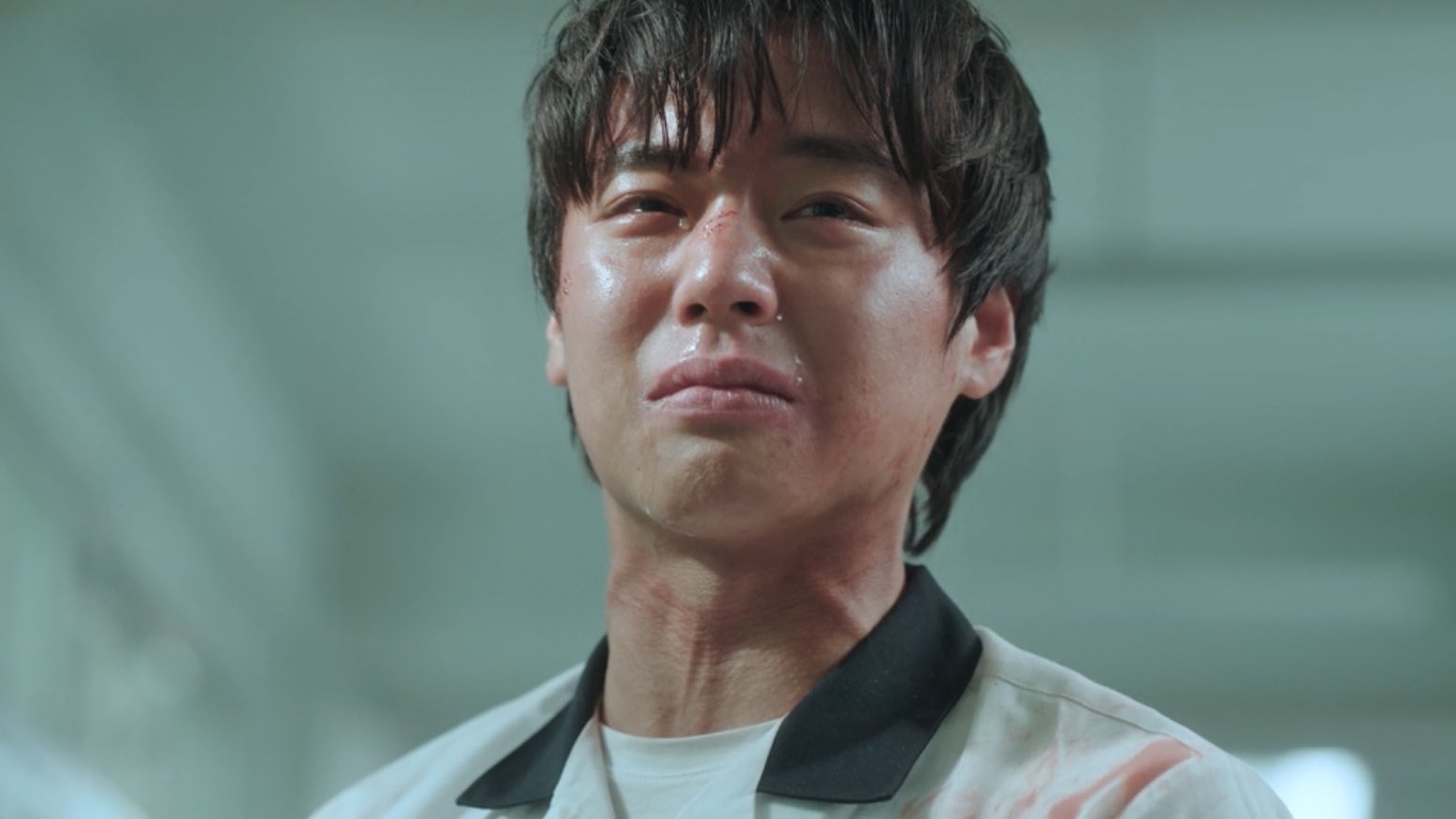
The criticism goes like this: “Why would he go that far for someone he only knew 41 days?”
It frustrates me the same way one-dimensional Beom-seok takes do — the ones that reduce him to an Instagram-obsessed attention-seeker and stop there. Both miss the psychological architecture the show spent eight episodes building.
The Parallel Structure
One of my most thoughtful subscribers left this:
“What makes Si-eun unbeatable in Episode 8 is the fact that at that point he has nothing left to lose. The first time Si-eun goes ballistic it happens for a similar reason. At the beginning, all he had in his life that mattered to him were academics. So when the bullies started messing with it, he lost control.”
The structure is exact. First explosion: his only source of meaning — academics — gets threatened. Final explosion: the person who replaced academics as his reason to function disappears, and Si-eun feels responsible for it.
The same subscriber continued:
“By the last episode he lost the most important person who saved him from his self-imposed loneliness. Him perceiving that he lost that relationship and also feeling responsible strips him of any kind of rhyme or reason. He attacks everyone because once again he has lost everything that mattered to him — except the second time it destroys him on a much deeper level.”
The Coping Mechanism
@morzsar also reframed,
“I don’t think by the time the drama starts Si-eun still values his studies because he wants his parents’ approval. That was probably the initial catalyst — to earn their love, prove his worth. But by the time we see him in the drama, he already gave up on his parents.”
The studying stayed. The reason it started didn’t.
“When you develop a coping mechanism it can be really hard to let go even after you realize it doesn’t solve the original problem. Especially if the coping mechanism can be explained to yourself as beneficial. Studying makes sense — you can get into good universities, earn a living. So why change it?”
Added
Si-eun’s parents essentially abandoned him while still living with him. His father — an Olympic silver medalist in judo — was visibly disappointed that his son turned out fragile and easily hurt. So Si-eun adapted into an isolated, stoic academic machine living in a rigid world where he denied himself food, sleep, and relationships.
The scene where little Si-eun overhears his parents fighting: they’re arguing about whether they should have had him at all. His father asks where his mother was when their son broke his arm. She responds that she agreed to have him because they were going to raise him together. His father says he hadn’t known the boy would get hurt so much.
Si-eun heard every word of that. Then he went to his room, locked the door, and did math.
That dinner scene with his mother — where Si-eun says “I’m not good at a lot of things” and she doesn’t catch it, just leaves for work — is the same dynamic, years later. He’s still making small bids for attention. She’s still not receiving them.
What the Contrast Reveals
Even with a fentanyl patch on his neck, Si-eun got only one question wrong.
On the day of finals when Su-ho goes unreachable, his exam paper is filled with slash marks where answers should be.
That’s not a plot detail. That’s the whole psychological argument of the show made visible. Su-ho wasn’t just a friend — he was evidence that Si-eun was capable of being loved. When that evidence disappears, and Si-eun believes he caused it, everything built on top of that foundation collapses.
Why “41 Days” Is the Wrong Unit of Measurement
The criticism assumes connection operates on adult timelines — that 41 days is objectively not enough to justify what Si-eun does. But connection operates on emotional impact, not duration.
For someone who spent their entire childhood doing math problems to survive their parents’ indifference, 41 days of genuine care doesn’t register as 41 days. It registers as the first time. And losing the first time, while believing you caused it, is a different category of loss entirely.
Park Ji-hoon built toward this from the first episode — the hunched posture, the hollow gaze, the triangle kimbap dinners alone. Every quiet detail was load-bearing. The explosion in Episode 8 wasn’t sudden. It was the only place all of that could go.
I randomly clicked on this drama on Netflix with no expectations. By Episode 7, when Su-ho collapsed, I was crying. And when Si-eun breaks that window — my first thought wasn’t this is unrealistic. It was that he could have turned that violence inward.
Full podcast episode on Si-eun’s psychology: 👉 HERE
📥 Free Ebook: Behind the K-Drama Subtitles — Weak Hero A character analysis that doubles your enjoyment of Weak Hero — built from the best subscriber discussions on this channel. 👉 Download here — it’s free
Read More: Si-eun’s Episode 8 Revenge: Why the “41 Days” Criticism Completely Misses the Point- The King’s Warden: 5 Hidden Layers You’ll Wish You Knew Sooner
- The Word “Upset” Doesn’t Cover It: A Curtain Up Class Episode 2 Review
- Weak Hero Class 1: Hidden Details You can’t unsee — Costumes, Callbacks & Cultural Context
- The Raft Broke. So Did Something Else.
- Weak Hero isn’t just an action drama; It’s a cautionary tale — Renewed Version