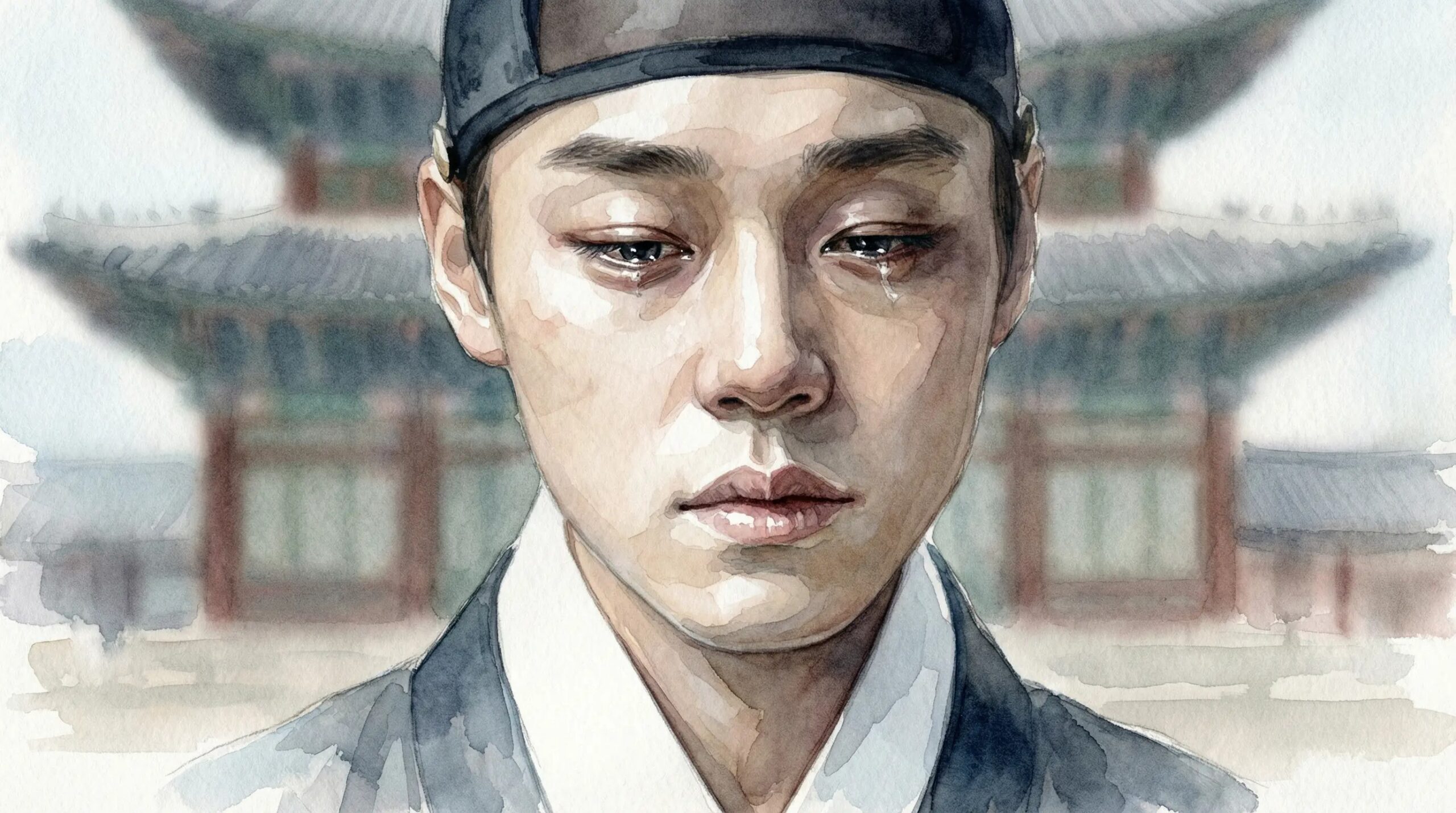
From Si-eun’s Desperation to Danjong’s Authority
The movie hasn’t even premiered yet, but Park Ji-hoon’s performance is already setting social media on fire.
Let me start with a comment from my YouTube subscriber Asuka:
“What the… A translation with context? glass shattering scream Thanks Jennie!!
You know, I got chills at 5’38. It’s a different sort of roar from the infamous cry of Si-eun’s soul at the end of WHC1.
Although in age the two characters are about the same, Danjong’s shout projects power and authority, and Si-eun’s pours out his brokenness and desperation.
My god, I love him.
I’m used to seeing inferior actors express pain the same way all the time: dull shouting, dull frowning, formulaic quick breaths… Park Jihoon is really premium goods, bravo to the dude.”
As Asuka noted, despite being an idol, there’s something unusually elusive, almost reclusive, about Park Ji-hoon. Behind those iconic aegyo moments, there’s always been a dead serious side. This role as Danjong proves it completely.
Critics Unanimously Call Him ‘The Best Discovery’
Film critics and media who attended advance screenings are unanimous. They’re calling Park Ji-hoon “the best discovery of this film.”
The Essence of Eye Acting
“His ‘eye light’ acting, precise enough to control even the amount of tears, delicately captures Lee Hong-wi’s emotional changes.
From the emptiness of a deposed king who has lost the will to live, to the gradual will to live again – all conveyed through his eyes alone.”
Even senior actor Yoo Hae-jin couldn’t stop praising him:
“On the day we shot the emotional scene, when I looked at Park Ji-hoon’s face, his eyes were already welling up.
That naturally brought out my own movements. From that moment, I no longer saw Park Ji-hoon – I saw the young Danjong.”
👇 Want to understand the tragic history of King Danjong? Check out my YouTube video below
🔗 Read the full historical context on my blog
Social Media Catches the Details
Looking at reactions on Twitter and online communities, you can see just how closely audiences are paying attention to the details of Park Ji-hoon’s performance.
One tweet caught my eye:
“This pretty guy looks exhausted and emaciated, his eyes are dull with no light, like he’s thinking ‘yeah, whatever, I’ll just die…’
But then you find out he’s a KING.
He seems powerless and incompetent, but he was raised well, so he’s picky about food, shoots arrows perfectly, and is super smart. His temperament is even gentle… wait, this character setup is too much”
It’s already known that Park Ji-hoon lost 15kg for this role. But he didn’t just create a thin body – critics agree he perfectly embodied that precariousness through his acting.
“He witnessed the deaths and torture of those who supported him, hearing their screams, but captured the sadness and anger of being unable to do anything through his restrained expression.
With barely any dialogue, the feeling of suppressing complex emotions was clearly transmitted to the audience.”
👇 Want to know more about the meticulous costume design in The King’s Warden?
🔗 Dive deeper into the historical accuracy on my blog
Acting the Transformation – From Despair to Hope
What film reviews consistently emphasize is Park Ji-hoon’s ability to express ‘change.’
“As he grows closer to the villagers of Cheongnyongpo through Eom Heung-do, he changes so much that his eyes seem to be replaced, making you forget those precarious moments.
Especially when shooting arrows, you can even feel his charisma.”
One critic wrote:
“Park Ji-hoon’s performance capturing ‘the will of a monarch’ is so vivid that it creates the illusion of thinking ‘this is what Danjong must have been like if he really existed.’”
Park Ji-hoon expresses Danjong’s inner transformation without exaggeration, conveying the character’s emotions through silence and eye contact alone. Critics note how impressively he builds up the despair, resignation, and the subtle wavering of will to live again, layer by layer.
👇 Want to know more about Han Myeong-hoe, the real kingmaker who killed a king?
🔗 Read the complete story on my blog
Why This Film’s Danjong Is Special
In countless historical dramas and creative works, Danjong has always existed only as a symbol of tragedy or background to Sejo’s story. But ‘The King’s Warden’ is different.
“This work adds cinematic imagination to Danjong’s life in exile, which has only been consumed as a supporting or minor role in countless creative works, shedding light on the life of ‘the human Lee Hong-wi.’”
Danjong is no longer just the unfortunate boy who lost his throne. He’s a human being who comes back to life as he mingles with the people of Gwangcheon-gol, laboring, eating, and laughing. The film directly confronts the time after being driven from the throne, restoring him as a human who chose relationships even in pain and breathed among people.
And at the centre of it all is Park Ji-hoon’s delicate performance.
The premiere is just days away now. On February 4th, meet the Danjong that Park Ji-hoon created in theaters.
I’ll be there on opening day and bring you my full review right after. For my international readers, it should hit streaming platforms soon – hang tight!
And I’ll bring you my full review.
Until then, if you want to catch more cultural context like this, the stuff that gets lost in subtitles, I write a weekly newsletter called Off Script.
Bite-sized cultural notes about Korean dramas and films. The layers your subtitles miss. The context that makes rewatches twice as good.
🔗 [Subscribe to Off Script here]
—Jennie
더 보기: Park Ji-hoon’s ‘King Danjong’ Performance Already Drawing Rave Reviews
- Notes from the Last Row: What “Let’s Eat Together” Really Tells Us About Choi Hyun-wook and Choi Min-sik
- The King’s Warden: 5 Hidden Layers You’ll Wish You Knew Sooner
- The Word “Upset” Doesn’t Cover It: A Curtain Up Class Episode 2 Review
- Weak Hero Class 1: Hidden Details You can’t unsee — Costumes, Callbacks & Cultural Context
- The Raft Broke. So Did Something Else.
⛔️ Copyright Disclaimer: All drama footage, images, and references belong to their respective copyright holders, including streaming platforms and original creators. Materials are used minimally for educational criticism and analysis with no intention of copyright infringement.
🚫 Privacy Policy: This site follows standard web policies and does not directly collect personal information beyond basic analytics for content improvement. We use cookies to enhance user experience and may display advertisements.