
Every stitch tells a story. Every layer holds a trap.
When the December 19th poster for The King’s Warden (왕과 사는 남자) dropped, my first thought wasn’t about Park Ji-hoon’s face—though, let’s be honest, his face is literally just art.
No, what stopped me cold was what he was wearing.
That deep blue-green gwanryongpo (곤룡포). The intricate sangtugwan (상투관) crown. The donggot pin piercing through his topknot. The royal gat perched perfectly on top.
Every single layer—from the collar embroidery to the hat—was meticulously, historically, devastatingly accurate.
And here’s what breaks my heart: the costume team knew exactly what they were doing.
Because historically, every piece of King Danjong’s royal costume was a cage.
The Blue Dragon Robe: Why Color Matters
Let’s start with that robe.
If you’ve watched Korean historical dramas, you’ve probably seen kings wearing hongryongpo (홍룡포)—the bright red dragon robe. That’s what most Joseon kings wore for daily court business.
But King Danjong’s robe in this poster? It’s blue-green.
And that’s not a random costume choice. That’s a historically loaded decision.
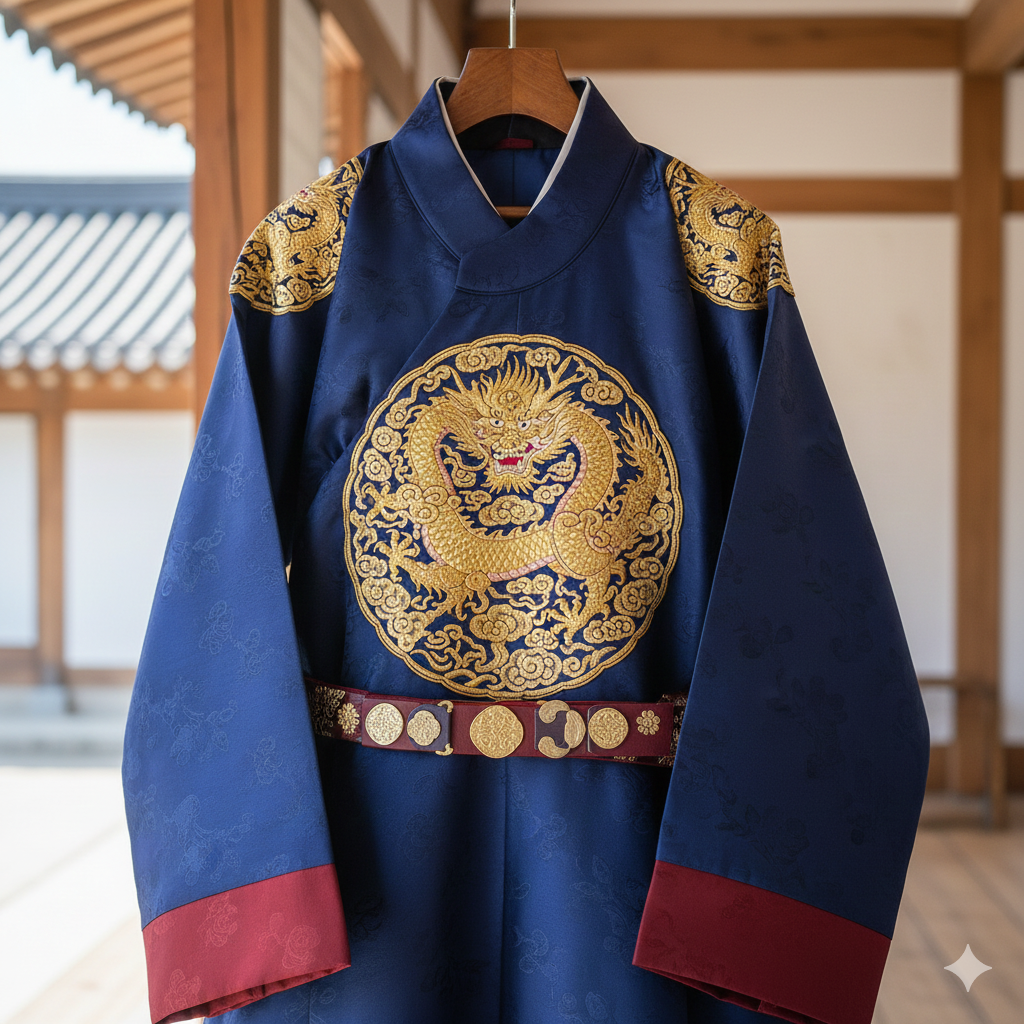
Early Joseon’s Blue Dragon Robe
Here’s the thing: Joseon’s first king, Taejo Yi Seong-gye, also wore a blue dragon robe.
According to the Annals of King Sukjong (숙종실록), Goryeo dynasty favored blue (청색), and Taejo continued this tradition in early Joseon. Scholars speculate this was because blue represented the East (동방) in the traditional obangsaek (오방색) five-color system.
It wasn’t until King Sejong’s reign in 1444 that Joseon kings officially switched to the red hongryongpo we’re familiar with today.
So why does Danjong wear blue in this film?
It’s hard not to see this as a deliberate choice. Maybe Director Jang Hang-jun wanted to show us visually what words can’t fully capture:
Danjong was never quite like other Joseon kings. He existed outside the normal flow of power, disconnected from the established order. His reign was an anomaly—brief, tragic, erased. That blue-green robe? It feels like a visual whisper:
This king doesn’t belong in the red.
The Dragon Embroidery: Woven Power, Stitched Trap
Now let’s talk about that dragon.
The golden dragon embroidered on the gwanryongpo is called yongbo (용보)—a circular badge featuring a five-clawed dragon (ojolyong, 오조룡). Only the king could wear a five-clawed dragon. The crown prince wore four claws (sajolyong, 사조룡), and the crown prince’s son wore three (samjolyong, 삼조룡).
In early Joseon (like Danjong’s era), these dragon badges weren’t separately attached—they were woven directly into the fabric or embroidered with gold thread onto the robe itself. The yongbo covered the chest, back, and both shoulders—four locations total.
According to costume historians, these badges were MASSIVE in early-mid Joseon. We’re talking chest-to-abdomen coverage. The costume team for The King’s Warden reportedly hand-crafted every piece of Danjong’s hanbok, including this intricate gold embroidery work.
And here’s the cruel irony: this symbol of absolute royal power couldn’t stop his uncle. It couldn’t protect him. It could only mark him as a target.
From Scalp to Sky: The 17 Layers
Okay, let’s break down everything on Danjong’s head, because this is where the costume team really flexed.
Sangtu (상투): The Topknot

The sangtu—or topknot—was the single most important marker of adult male status in Joseon society.
Boys wore their hair in a long braid (daenggi, 댕기). But once you got married or completed your coming-of-age ceremony (gwanrye, 관례), you tied your hair up into a topknot at the crown of your head.
No topknot = not an adult. Period.
Even if you were 40 years old, if you weren’t married and didn’t have a topknot, people spoke down to you (hataetmal, 하댓말). Conversely, if you were 15 and married, you got adult respect.
Some unmarried men would tie a fake topknot (geonsangtu, 건상투) just to avoid being disrespected by strangers.
Fun historical fact: When tying a topknot, men would shave the crown of their head (baekho chinda, 백호친다) to allow heat to escape. Otherwise, all that hair piled on top would be unbearably hot in summer.
Manggeon (망건): The Black Headband
The manggeon is that black mesh headband you see around the forehead in sageuk dramas. It served two purposes:
- Keep hair from falling into your face
- Hold the topknot structure in place
Think of it as the foundation for everything else.
Donggot (동곳): The Hairpin
Here’s where it gets fancy.
The donggot is a pin that pierces through the topknot to hold it in place. And this wasn’t just functional—it was a status symbol.
Common people used wooden or copper donggot. But the upper class? Gold, silver, jade, amber, coral, agate, crystal.


According to historical records, aristocratic men would show off their wealth and taste through their donggot. It was one of the few acceptable ways for Joseon men to express personal style.
In the poster, you can see Danjong’s donggot—a metallic pin, likely silver—gleaming at the top of his head.
Sangtugwan (상투관): The Topknot Crown
And THIS is the piece most international viewers have never heard of.
The sangtugwan is a small crown worn over the topknot to cover it. Because in Joseon etiquette, showing your bare topknot indoors or in formal settings was considered rude—like walking around shirtless.
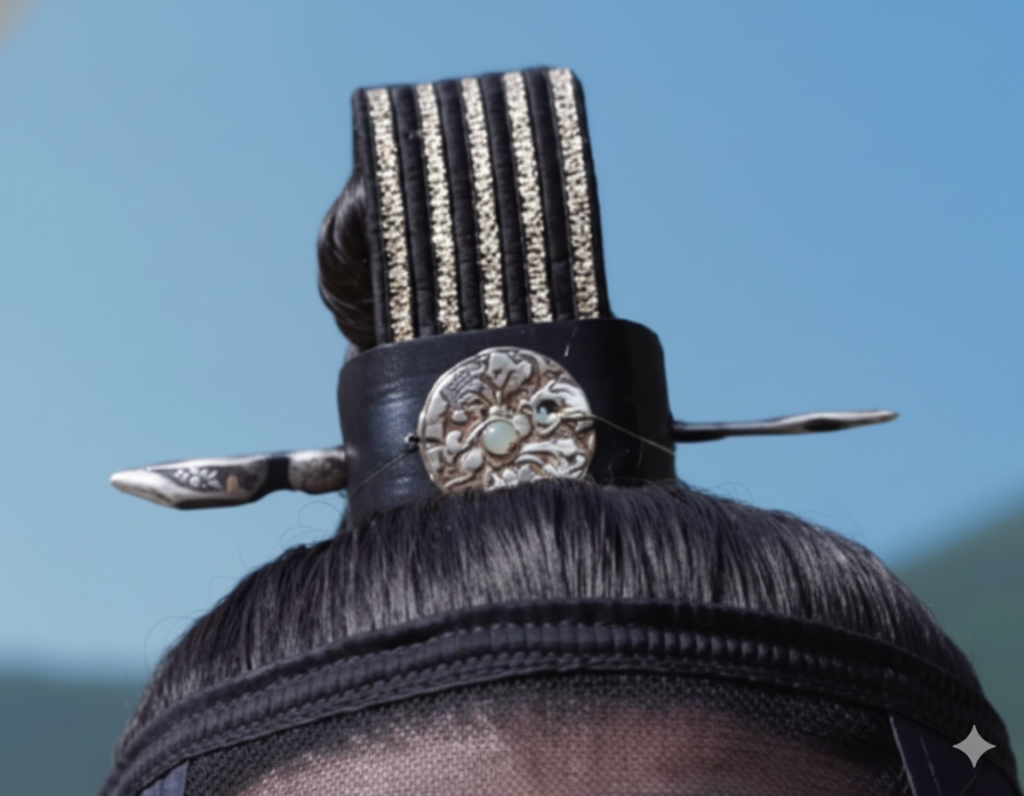
(Image note: Close-up of a Sangtugwan detail from The King’s Warden poster. Image has been upscaled using AI for clarity.)
Sangtugwan were used primarily by royalty and upper-class yangban (양반). They were made from wood, thick paper (jangji, 장지), leather, horn, or bone, then lacquered black.
The shape? It’s basically a miniature version of the yangwan (양관) or wonyugwan (원유관)—formal ceremonial crowns.
Here’s the Netflix Kingdom connection:
If you watched Kingdom, you’ve seen Crown Prince Lee Chang (played by Ju Ji-hoon) wearing a sangtugwan. His is slightly different in style—rounder, shorter—because Kingdom is set in the late 1500s/early 1600s, while The King’s Warden is set in 1457.
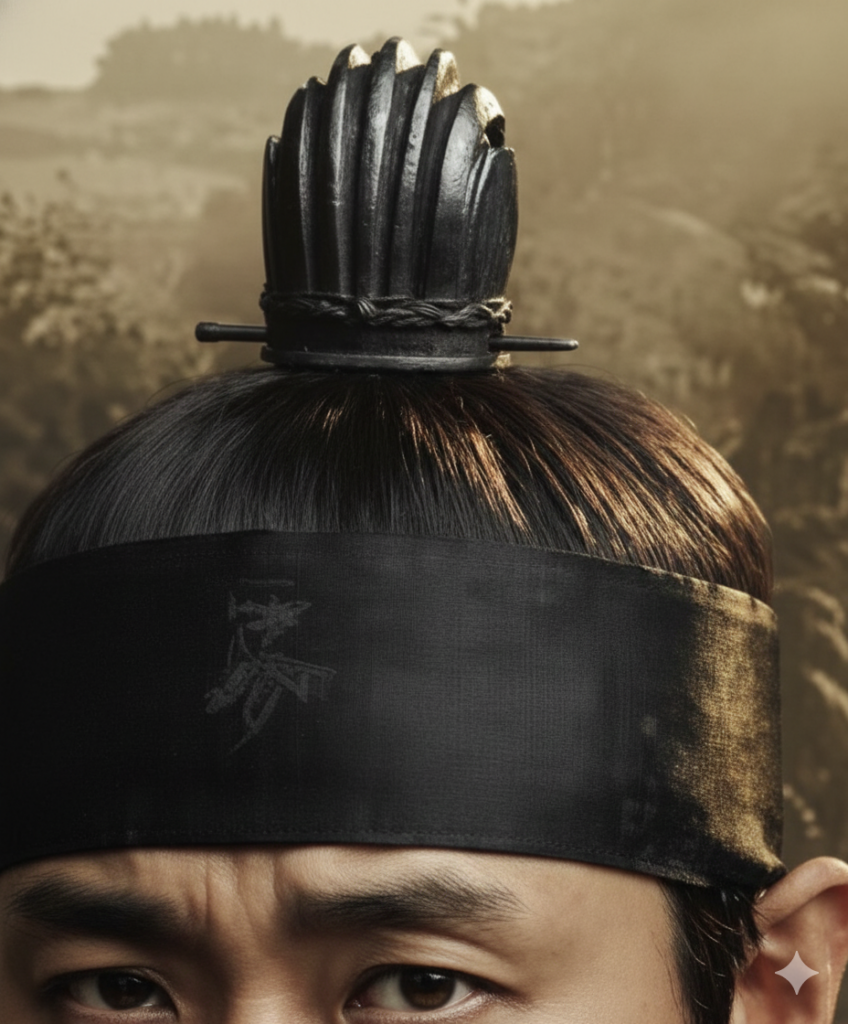
(Image note: Crown Prince Lee Chang’s sangtugwan from Netflix’s Kingdom, Season 1. Image has been upscaled using AI for clarity.)
The evolution of Korean royal headwear across just 150 years is fascinating. Even the sangtugwan changed shape, just like the gat did.
Gat (갓): The Royal Hat
And finally, we arrive at the iconic Korean hat.
The gat—or heungnip (흑립, “black hat”)—is probably the single most recognizable piece of traditional Korean menswear to international audiences, especially after Kingdom went viral on Netflix.

But here’s what most people don’t know: the shape of the gat changed dramatically across different eras of Joseon.
The gat consists of two parts:
- Daewoo (대우): The cylindrical crown that sits on top of the head
- Yangtae (양태): The wide, circular brim
In King Sejong’s era (15th century), gats had rounded crowns and moderately wide brims.
By the 17th century (King Hyojong’s time), the daewoo got TALL and the yangtae got SO WIDE that historical records literally complain about people not being able to fit through doorways.
The Annals of King Hyojong record officials requesting a ban on oversized gats because they were “interfering with movement through gates.”
In the 18th century (Kings Yeongjo and Jeongjo), brims stayed wide, but men started accessorizing with elaborate gasgkeun (갓끈)—hat strings made from amber, jade, coral, or tortoiseshell that hung down to the chest.
By the 19th century, gats shrank again due to reform policies under Heungseon Daewongun.
So what does this mean for The King’s Warden?
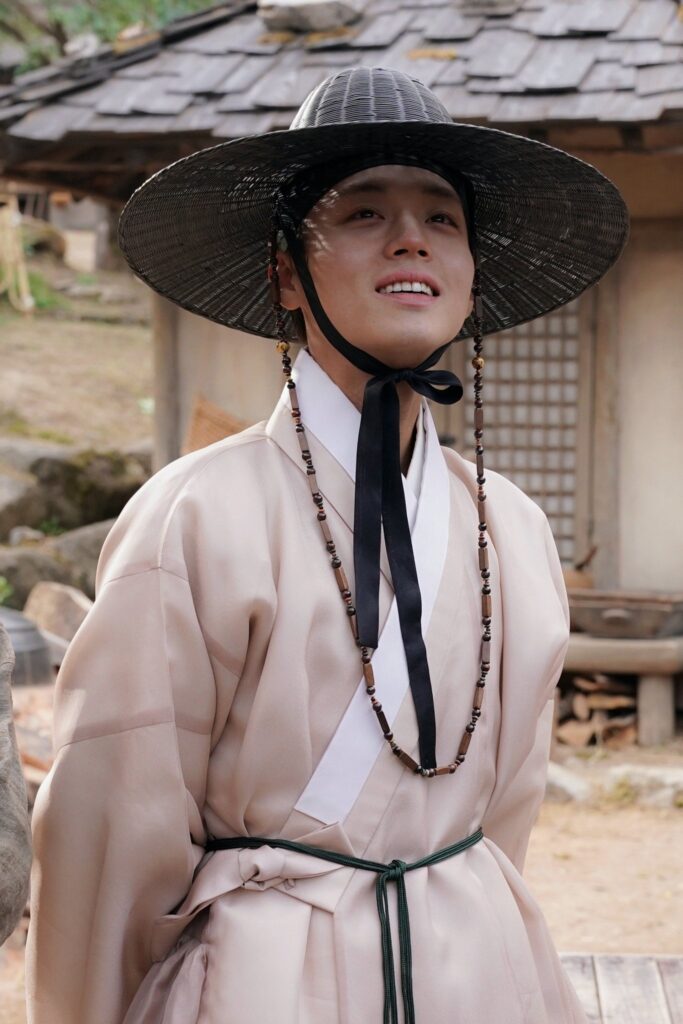
This film is set in 1457—early Joseon. The gat should be shorter, more rounded, with a wider base compared to the tall, angular gats you see in Kingdom (late Joseon).
And guess what? The costume team got it right.
Look closely at Danjong’s gat in the poster. The crown is lower. The shape is rounder. The proportions match mid-15th century styles perfectly.
This is the level of historical detail we’re talking about.
The Collar Embroidery: A Detail You Almost Missed
One more thing I need to point out.
If you zoom in on Danjong’s hanbok collar in the poster, you’ll notice intricate embroidery along the neckline.
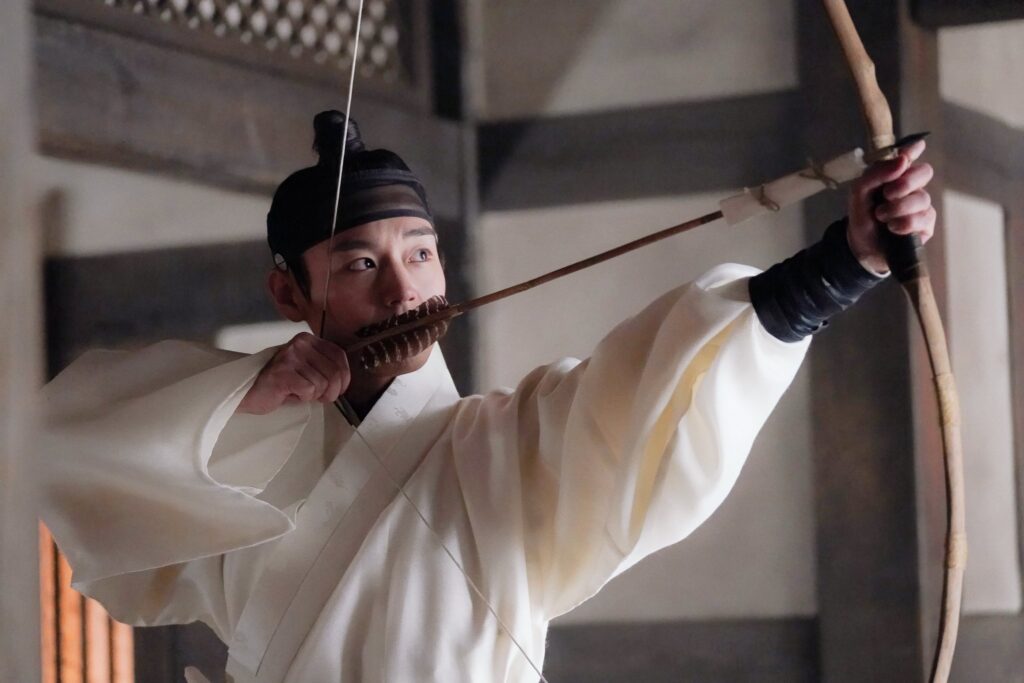
This isn’t just decorative. In Joseon royal costume, even the smallest details carried meaning—rank, occasion, season.
The fact that the costume team hand-made every piece of this hanbok—including hand-stitching this collar embroidery—tells you how seriously they’re taking historical authenticity.
This isn’t a rental costume. This is a reconstruction.
Why This Matters
Here’s what gets me about all of this.
Every single layer—from the blue gwanryongpo to the gold donggot to the perfectly period-accurate gat—was designed to communicate power, dignity, authority.
But in Danjong’s story, none of it mattered.
He wore the dragon. He had the crown. He sat on the throne.
And his uncle took it all anyway.
17 layers of dignity. Zero layers of protection.
The costume becomes a visual metaphor for Danjong’s entire tragedy: he had every symbol of kingship except the one thing that actually mattered—power.
And that’s why this poster, this costume, this attention to historical detail, hurts.
Because the costume team knew. Director Jang Hang-jun knew. Park Ji-hoon knew.
They dressed Danjong in every marker of royal authority precisely to show us how meaningless those markers were when power itself had already slipped away.
The King’s Warden (왕과 사는 남자) releases February 4, 2026.
I’ll be there, tissues in hand, watching every stitch of that costume tell a story that Korean history tried to erase for 241 years.
Thanks for reading. See you in the theatre.
References & Further Reading:
- Korean Hanbok Cultural Encyclopedia: Gwanryongpo
- Annals of King Sejong (세종실록): First adoption of red dragon robes
- Annals of King Sukjong (숙종실록): Discussion of early blue dragon robes
- National Folk Museum of Korea: Joseon Male Headwear Collection
- Costume research: Evolution of the gat across Joseon dynasty
⛔️ Copyright Disclaimer: All drama footage, images, and references belong to their respective copyright holders, including streaming platforms and original creators. Materials are used minimally for educational criticism and analysis with no intention of copyright infringement.
🚫 Privacy Policy: This site follows standard web policies and does not directly collect personal information beyond basic analytics for content improvement. We use cookies to enhance user experience and may display advertisements.
답글 남기기