
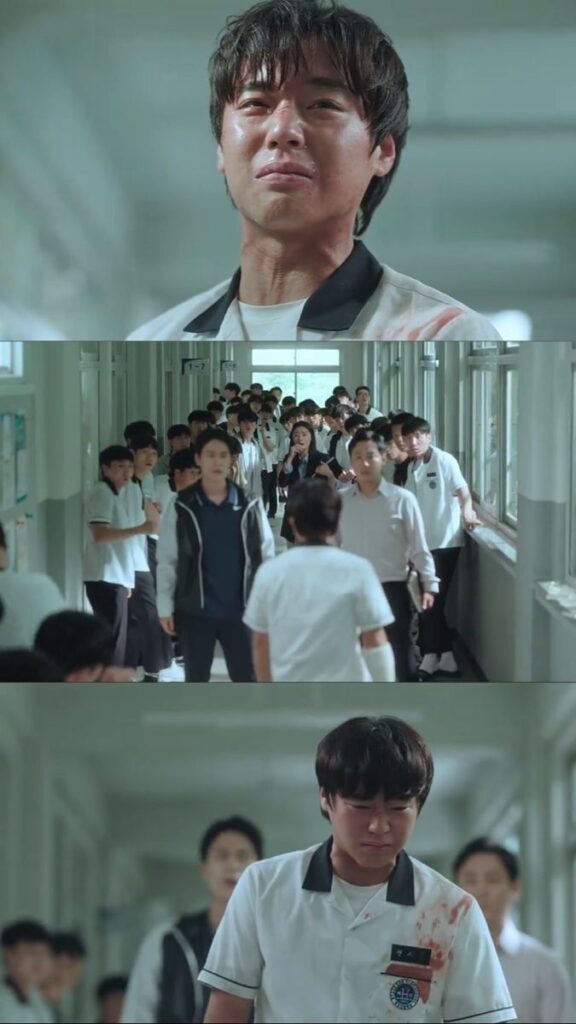
📍 The criticism that makes me want to scream: People saying Si-eun’s revenge lacks “plausibility” is as frustrating as those one-dimensional takes that reduce Beom-seok to just “an Instagram-obsessed attention-seeker” blinded by jealousy ☠️ If you’re a true fan of this series, you can’t help but follow the emotional trajectory that leads to Si-eun’s explosive finale.
📍 진짜 화나는 비판: 시은이의 복수가 “말이 안 된다”고 하는 사람들… 범석이를 그냥 “인스타 관종에 질투에 눈멀었다” 이러한 일차원적인 시각만큼이나 답답하다 ☠️ 진짜 이 시리즈의 팬이라면 시은이의 폭발적인 피날레로 이어지는 감정적 궤적을 따라갈 수밖에 없다.
Today I’m breaking down why the “41 days of friendship could explode like that?” approach completely misses the psychological masterpiece we actually witnessed.
(고작 41일 친구였는데 그렇게까지 폭발한다고?)
⚠️ Please ignore any Korean text that appears – I’ve noticed Korean fans also visit my blog, so I include Korean notes to help their understanding 🙏
📢 Fair Use Notice
This post contains copyrighted material from “Weak Hero” (© Wavve/Netflix) used for educational analysis, criticism, criticism, and commentary purposes under fair use doctrine. All rights belong to original creators.

The Shallow Take That Makes Me Want to Scream 🙀
The criticism that Si-eun’s revenge in Weak Hero Class 1’s final episode lacks credibility is, well, as hard for me to accept as those one-dimensional reviews that dismiss Beom-seok as merely an Instagram-obsessed attention-seeker blinded by jealousy toward Su-ho. If you’re a true fan of this series, I think you cannot help but follow the emotional trajectory that leads to Si-eun’s explosive finale.
“Why would he go that far for a friend he only knew for 41 days?”
This concern makes me sigh just as much as when people simply interpret Beom-seok as just a crazy attention-seeker on Instagram and bash him. Like… why can they only think that way? 😅
Both criticisms reveal what I see as the same fundamental problem: a complete misunderstanding of what Weak Hero actually portrays. It’s the same superficial thinking that reduces complex psychological storytelling to simple plot mechanics. These interpretations, in my view, miss the sophisticated emotional architecture that the series builds over eight carefully crafted episodes.
☠️ 두 비판 다 결국 같은 문제를 보여준다: 약한영웅이 진짜 뭘 말하려는지 아예 못 알아듣는 거다. 복잡한 심리 드라마를 그냥 단순한 스토리 진행 정도로 보는 얄팍한 시각이 똑같다. 이런 식으로 보면 8회에 걸쳐 치밀하게 쌓아올린 감정적 구조를 완전히 놓칠 수밖에 없다.

When My Subscribers Become Psychology Professors
One of my most thoughtful subscribers, @mor****, left this analysis that I keep coming back to:
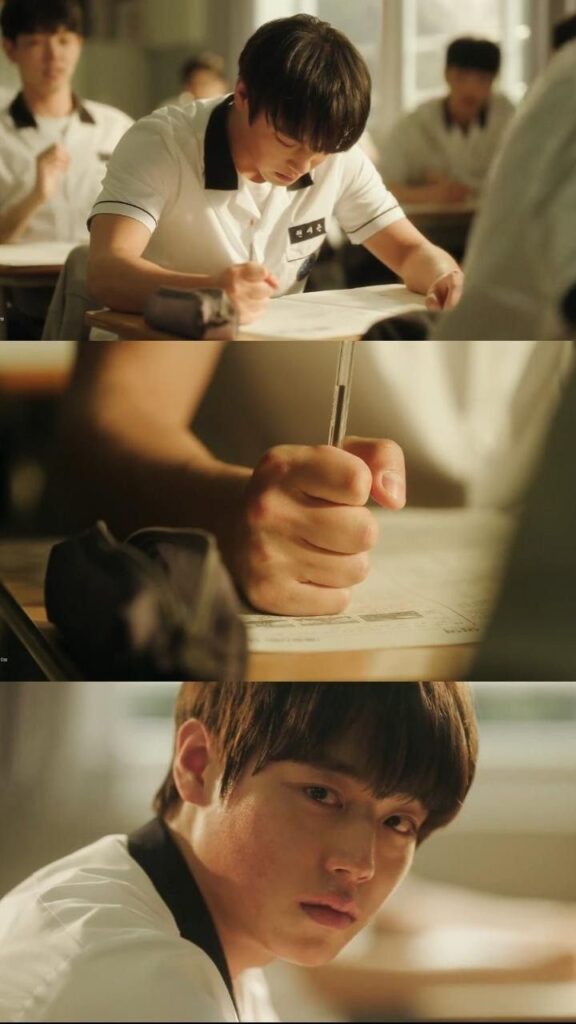
I completely agree with you that Si-eun going ballistic feels totally realistic. I think that what makes Si-eun unbeatable is the fact that at that point he has nothing left to lose.
It is a great parallel in the drama, that the first time Si-eun goes ballistic it happens for a similar reason. At the beginning all he had in his life that mattered to him were academics. So when the bullies started messing with it he lost control.
이 드라마의 훌륭한 대칭구조는 시은이가 처음 폭발했을 때도 똑같은 이유였다는 점입니다. 초반에 시은이 인생에서 그에게 소중했던 건 오직 공부뿐이었습니다. 그래서 일진들이 그걸 망가뜨리기 시작하자 이성을 잃고 말았던 겁니다.
This is exactly it, I think.
🤯 The parallel structure between Si-eun’s first explosion and his final one isn’t just clever writing – it feels to me like the emotional mathematics of a boy whose entire world gets reconstructed and then destroyed. 🤯 시은이의 첫 폭발과 마지막 폭발 사이의 대칭구조는 그냥 잘 쓴 대본이 아니라 – 자신의 모든 세상이 다시 만들어졌다가 다시 파괴된 한 소년의 감정적인 수학 등식과 같다는 생각이 든다.
They continued with this devastating insight:
By the last episode he lost the most important person who saved him from his self-imposed loneliness. Him perceiving that he lost that relationship and also feeling responsible strips him of any kind of rhyme or reason. He attacks everyone because once again he has lost everything that mattered to him, except the second time when it happens it destroys him on a much deeper level.
마지막 화에서 그는 자신이 스스로 만든 고독에서 (his self-imposed loneliness) 구해준 가장 소중한 사람을 잃었어요. 그 관계를 잃었다고 느끼고 동시에 자신이 책임이 있다고 느끼는 것이 그에게서 모든 이성과 논리를 빼앗아버렸죠. 그가 모든 사람을 공격하는 이유는 다시 한 번 자신에게 소중했던 모든 것을 잃었기 때문인데, 두 번째로 이런 일이 일어났을 때는 훨씬 더 깊은 차원에서 그를 파괴시켰어요.
Reading this comment, well, I literally had to pause and think about how perfectly they captured what makes Si-eun’s breakdown so devastating.

And then @mor****, dropped this psychological bombshell that, hmm, completely rewired my understanding:
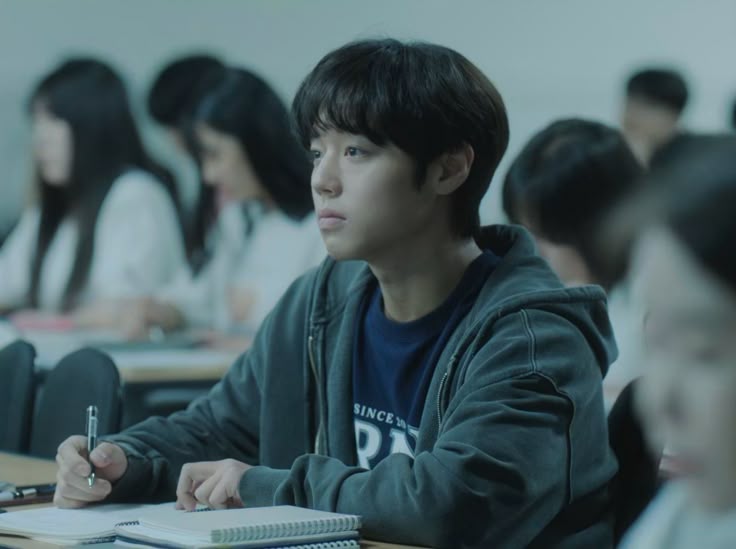
I don’t necessarily think that by the time the drama starts Sieun still values his studies the most because he wants to receive the approval of his parents. It’s highly likely that that was the initial catalyst of his laser-focused academic journey (to earn their love/prove his worth) but to me it felt like he already gave up on his parents by the time we get to see him in the drama.
드라마 시작 시점에서 시은이가 아직도 부모 인정받으려고 공부에 매달린다고는 보지 않았어요. 처음에 그렇게 공부에만 미친 듯이 집중하게 된 계기는 분명 그거였겠지만 (부모 사랑 받으려고/자기 존재 가치 증명하려고) 드라마에서 우리가 만나는 시은이는 이미 부모한테는 기대를 접은 상태였던 것 같습니다.
This hit me like a truck, honestly. I had to tell them:
That scene where Si-eun has dinner with his beautiful mother was devastating, I think… when he tells her ‘I’m not good at a lot of things’ but his mom doesn’t pick up on her son’s small plea for attention and just leaves right away for work…
But there’s something even deeper here that another insightful subscriber, @elaine32****, helped me understand about Si-eun’s childhood trauma. They pointed out something that, well, completely changed how I view Si-eun’s psychology:
Si-eun’s parents have essentially neglected and/or abandoned him. They expect him to be self parenting and almost perfect. But his father, an Olympic silver medalist in judo, has also, clearly, been disappointed that his son has turned out to be frail and easily hurt. So, Si-eun has adapted accordingly. He’s become an isolated, stoic, scholastic automaton who lives in an extremely rigid world where he denies his basic needs for food, sleep, and relationships.
시은의 부모는 본질적으로 그를 방치하고/또는 버렸어요. 그들은 그가 스스로를 양육하고 거의 완벽하기를 기대하죠. (self parenting and almost perfect) 하지만 유도 올림픽 은메달리스트인 그의 아버지는 또한 분명히 자신의 아들이 허약하고 쉽게 다치는 아이로 자란 것에 실망했어요. 그래서 시은은 그에 맞게 적응했죠. 그는 고립되고, 금욕적이며 (stoic), 학구적인 자동기계가 되었고, 극도로 경직된 세상에서 살고 있어요 – 그곳에서 그는 음식, 잠, 그리고 인간관계라는 기본적인 욕구들을 거부하며 살아가고 있죠.
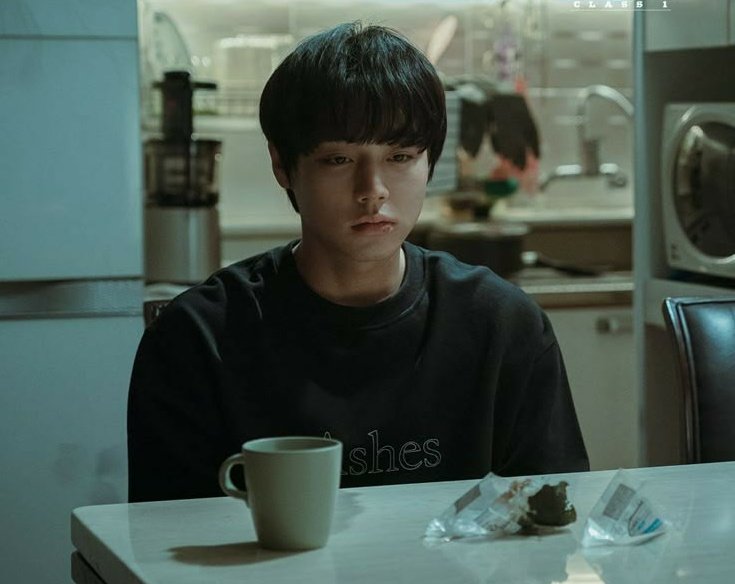
This analysis really struck a chord with me because it explains so much about the meticulous directing choices in Weak Hero. Since they had to compress a vast webtoon into just 8 episodes, every single scene carries meaning – like when we see Si-eun eating triangle kimbap for dinner or his empty, hollow gaze.
These precise details about Si-eun’s background and circumstances aren’t just character development – they’re carefully crafted groundwork to make his final explosive breakdown feel completely believable and inevitable.
In the subtitles that I saw (for that scene where little Si-eun overhears his parents fighting)? They were clearly arguing about whether or not they should have had him and it was obvious that they were both regretting the decision. He had broken his arm. Dad was asking mom where she was when it happened. She shot back that she agreed to have him because they were going to raise him together. And dad said he hadn’t known that the boy would get hurt so much.
제가 본 자막에서는 (어린 시은이가 부모 싸우는 걸 듣게 되는 그 장면에서) 부모가 완전히 시은이를 낳은 걸 후회하면서 서로를 원망하고 있었습니다. 시은이는 팔을 다친 상태였고요. 아빠가 엄마한테 그때 어디 있었냐고 따지니까, 엄마는 같이 키우자고 해서 낳기로 한 건데! 라고 받아쳤죠. 아빠는 이 아이가 이렇게 자주 다칠 줄은 몰랐다고 합니다.
Reading this made my heart break, honestly. The psychological impact of a child hearing their parents regret having them… I think that kind of rejection would fundamentally reshape how someone approaches relationships for the rest of their life.
@elaine32**** explained the aftermath:
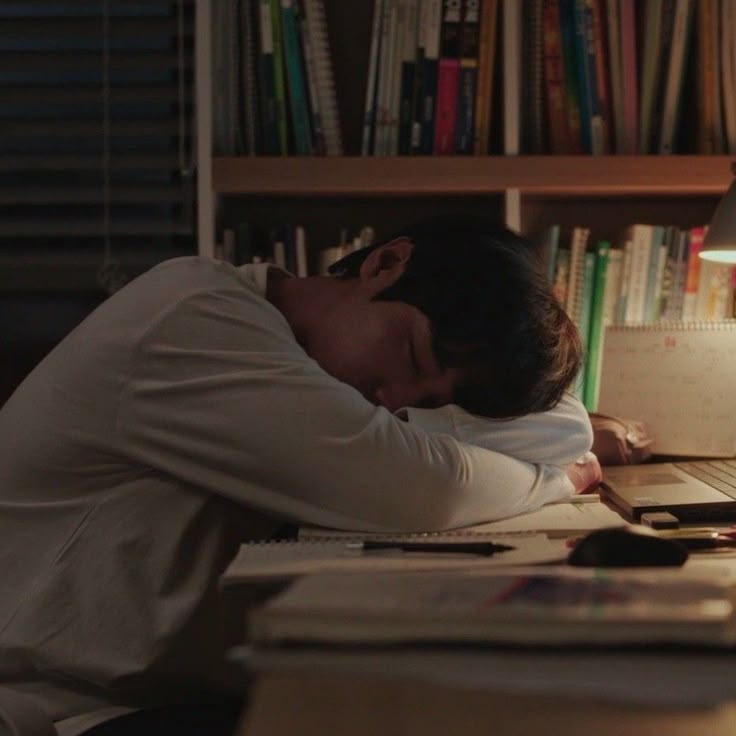
Little Si-eun would have been convinced that he was unwanted, (and a disappointing, inconvenient problem) after hearing that, so he goes to his room, locks the door and does math. Which became his way of dealing with the fact that his parents didn’t want him. He locks everyone and everything out by only doing school work.
This connects perfectly to what @morzsar**** was saying about coping mechanisms, I believe:
When you develop a coping mechanism it can be really hard to let go of it or change the routine, even if you realize that it doesn’t solve the original problem. Especially if the coping mechanism can be explained to yourself as beneficial. Studying makes sense after all, you can get into good universities, earn a living etc. So why change it?”
The conversation continued, and I found myself sharing something personal:
I actually watched all 8 episodes in one night with zero expectations and no prior knowledge… I just randomly clicked on this drama on Netflix with the remote. By episode 7… you know, when Su-ho collapses… I was like ‘wow, I’ve fallen down a rabbit hole I never saw coming’ and I was crying while watching it.
So I also… up until that moment when Si-eun breaks the window… I thought ‘ah, Si-eun could have hurt himself in the most harmful way possible…’ Since I had those thoughts, the scene where he completely destroys the bullies who did that to Su-ho didn’t feel unrealistic to me at all…”
“그래서 저도… 시은이 유리창을 깨는 그 순간에 ‘아, 시은이 자신을 가장 해로운 방식으로 해칠 수도 있었겠구나…’라고 생각했어요. 그런 생각을 했기 때문에, 그가 수호를 코마 상태에 빠지게 한 아이들을 완전히 박살내는 장면이 전혀 비현실적으로 느껴지지 않았어요…”
The Language of First Love (And Why It Matters)
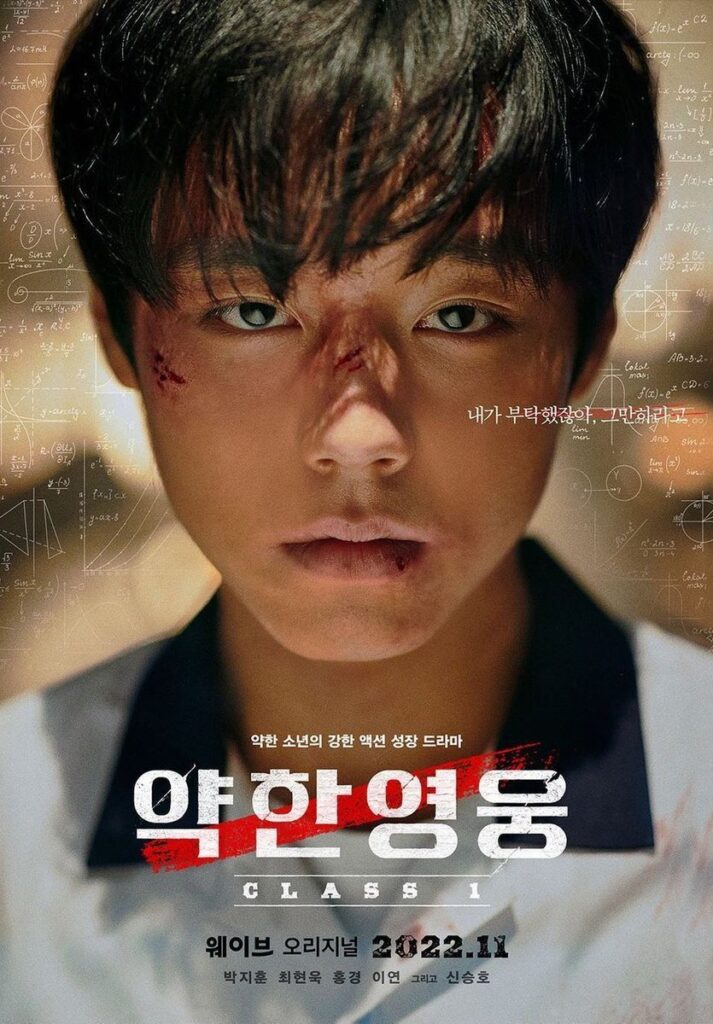
Here’s where I think Director Yoo Soo-min’s genius really shows. When he called Su-ho Si-eun’s “first love,” he wasn’t necessarily talking about romance – he was talking about what feels to me like the overwhelming flood of emotions that comes with experiencing genuine care for the first time.
For boys who have lived in isolation their entire lives, I believe Su-ho’s sincere friendship brought about a tsunami of surprise, gratitude, happiness, confidence, joy… and many other emotions that cannot be expressed in words. I think there is only one word that can express all of those feelings: “love.”
The contrast is heartbreaking: even with a fentanyl patch on his neck, Si-eun only got one question wrong, but when Su-ho disappeared, his academic world crumbled. For a teenager who had been emotionally isolated for years, Su-ho wasn’t just a friend – he was proof that connection was possible, that Si-eun wasn’t fundamentally unlovable.
이 대조가 정말 가슴 아프다: 목에 펜타닐 패치까지 붙이고도 한 문제만 틀렸던 시은이가, 수호와 연락이 닿지 않은 기말고사 날… 시험지에는 빗금 투성이다. 몇 년째 감정적으로 완전히 동떨어져 살던 아이에게 수호는 그저 친구가 아니었다 – 자신도 누군가와 연결될 수 있다는 희망이었고, 자기가 아예 사랑받을 자격이 없는 존재가 아니라는 증명이었던 것이다.


Watching Si-eun’s breakdown reminded me of my school days and a friend who was always at the top of our class. She quietly confessed that she constantly thought about how to die without pain…
Even though this happened so long ago, I remember that moment vividly because it showed me how brilliantly performing students can hide such devastating inner worlds. Si-eun’s character feels painfully real because kids like him – the ones who seem to have everything under control – are often the ones drowning silently.

I’m reminded of this girl from my school days who was just like Si-eun – only studied, didn’t make any friends, and was valedictorian. She was a girl but I heard she became a doctor later. That girl also never talked to anyone except for necessary words… no one bothered her either. She sat right in front of the teacher’s desk and studied all day, and just like Si-eun, her back was always hunched over. Watching Si-eun’s breakdown felt painfully real because kids like him – and her – are often the ones drowning silently behind their perfect grades.
The “41 days” criticism completely misses the psychological reality – when someone has been alone for most of their life and finally experiences deep connection, losing it doesn’t just hurt, it validates every fear about relationships being temporary and themselves being unworthy of love.
“41일” 비판은 심리적 진실을 아예 못 보고 있다 – 거의 평생을 스스로 고립되어 있던 소년이 처음으로 진짜 연결을 느꼈다가, 그걸 잃게 되면 단순히 마음이 아픈 정도라고 할 수 없을 것이다. 자기는 애초에 사랑받을 만한 인간이 아니었다는 걸 다시금 증명받게 되는 순간이 되는 것이다.
The Transformation and the Inevitable Fall

Su-ho’s entrance into Si-eun’s life represented a complete disruption of his carefully constructed emotional defense system. For the first time, Si-eun experienced what it felt like to matter to someone, to be protected, to be cared for without conditions or expectations of academic performance.
This transformation runs deeper than friendship. It’s about a fundamental restructuring of Si-eun’s understanding of his own worth and place in the world. Su-ho didn’t just save Si-eun from bullies; he saved him from a lifetime of emotional isolation.
When Su-ho falls into a coma, Si-eun doesn’t just lose a friend – he loses his proof that love and connection are possible. Worse, he loses the person who taught him that he was worthy of such connection.
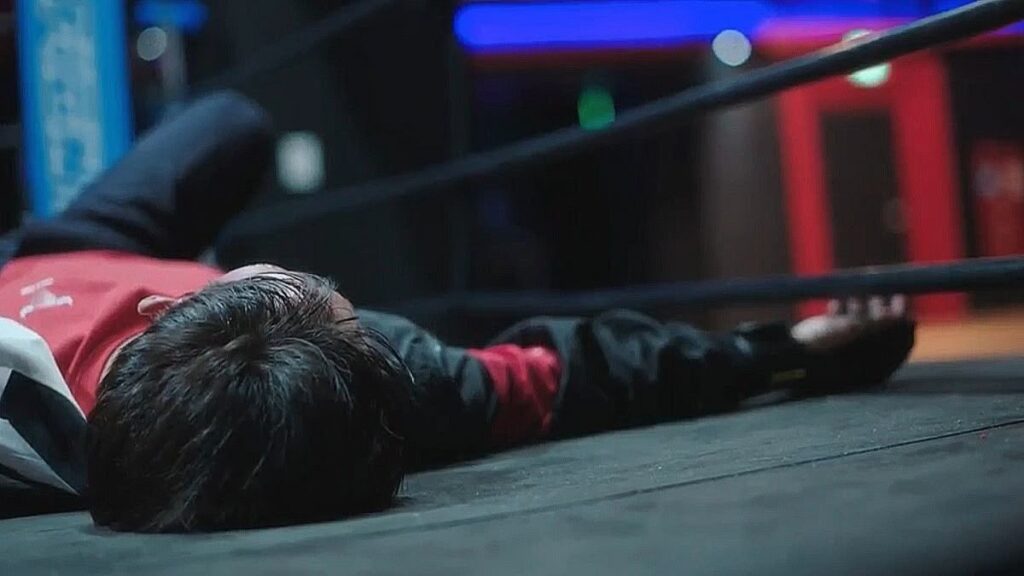
“When someone gets to this mental state there is no telling what could happen. The future and the consequences don’t matter anymore.”
“앞일이고 뭐고 아무것도 상관없어진다”
The Script Book Reality
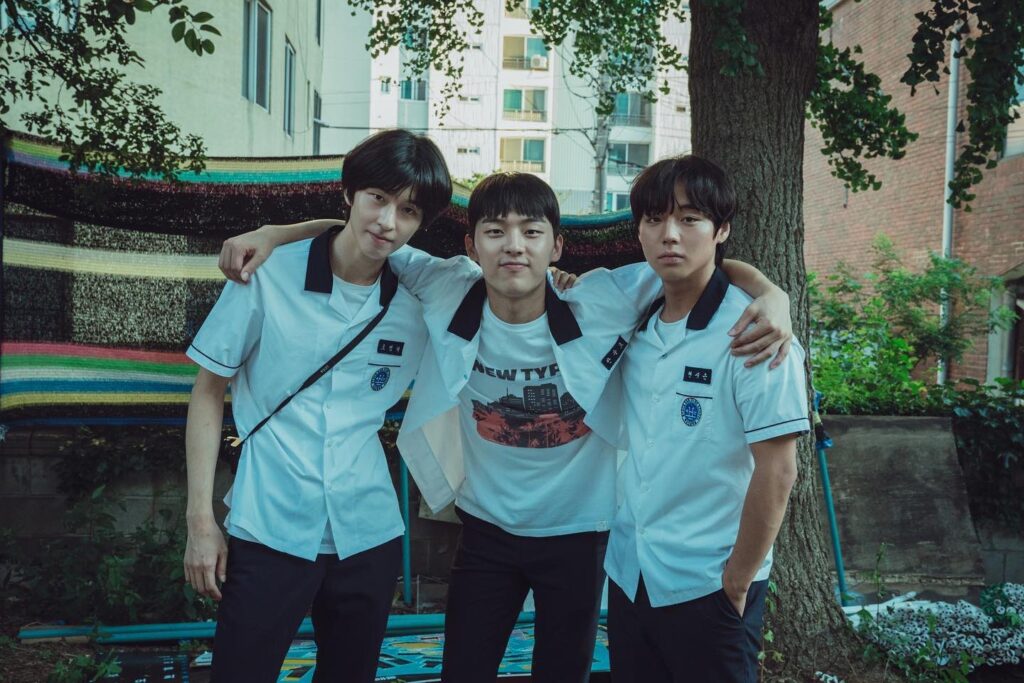
When you look at the script book, it feels kind of… dry overall, actually. But the three actors brought life to that dryness in a way where you can only see them as Su-ho, Beom-seok, and Si-eun. That was so incredible to me.
Maybe I’m doing some stupid romantic thing like Seong-je said 😂, but I think that’s similar with any script book you look at. If I were a director who wrote the screenplay, I think I’d cry tears of joy watching the actors breathe life into it on set!
Park Ji-hoon’s portrayal of Si-eun’s psychological journey throughout the series creates a foundation that makes his final explosion feel inevitable rather than sudden. The quiet moments of connection, the small smiles, the gradual opening up – all of these details build toward a character whose world had been completely restructured around his relationship with Su-ho.
박지훈이 시리즈 전반에 걸쳐 보여준 시은이의 심리적 여정은 그의 마지막 폭발이 갑작스럽게가 아니라 필연적으로 느껴지게 만드는 토대를 만들어낸다. 조용히 교감하는 순간들, 살짝살짝 보이는 미소, 조금씩 마음을 여는 과정 – 이런 세세한 장면들이 모여서 수호와의 우정으로 인하여 (범석이와의 우정도 물론이다) 완전히 새로 만들어진 세상에서 사는 캐릭터를 보여준다.
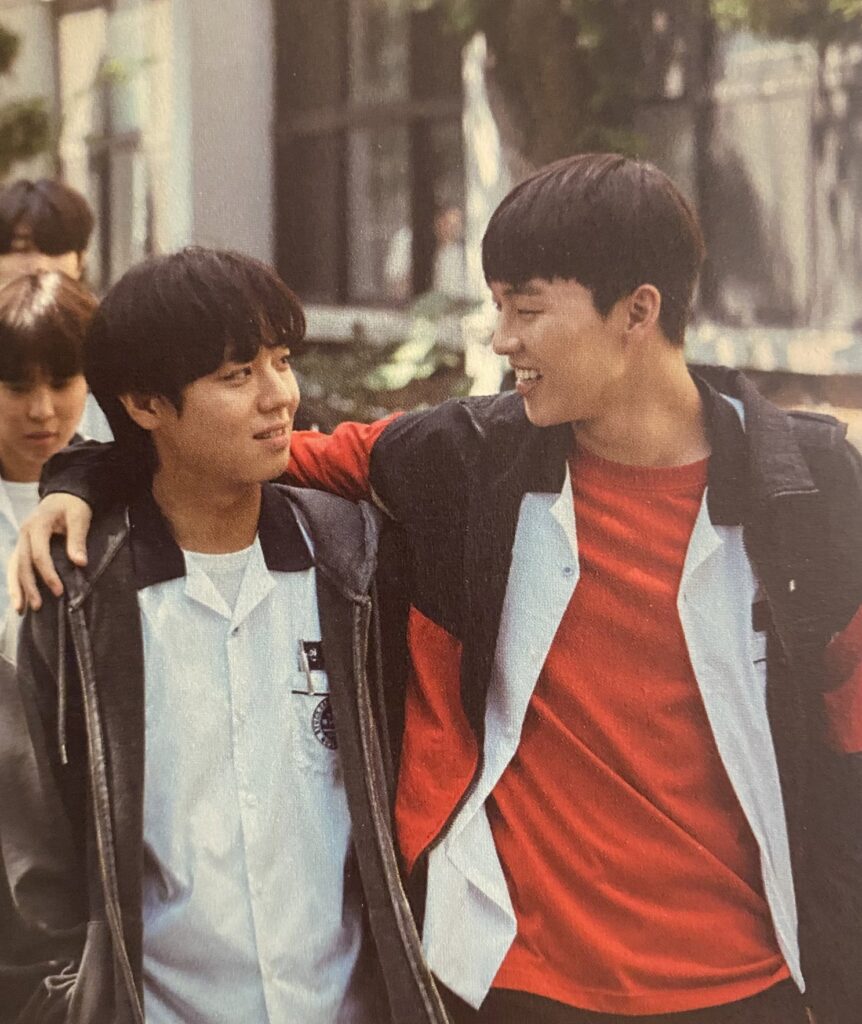
The Genre Balance That Actually Works
This drama isn’t actually about boys’ love in a sexual or romantic way – they totally avoided those directing elements. When Director Yoo Soo-min talked about “first love,” he meant that for directing Su-ho and Si-eun’s scenes, they borrowed the back-and-forth dynamics you’d see between male and female leads in romantic comedies.
연출적으로 유수민 감독님도 말했듯 수호와 시은이의 장면 연출에서 로맨틱 코미디 요소를 가져왔음 (As the director mentioned, it’s true that they borrowed romantic comedy elements in directing Su-ho and Si-eun’s scenes)
But I think the production team found the perfect balance.
They directed it so well that it made fans spread their wings of imagination in all sorts of ways, like Park Ji-hoon said. I also found it fun watching the bromance between characters, and I think it was brilliant how the directors didn’t rashly define the boys’ emotions but let viewers imagine for themselves.
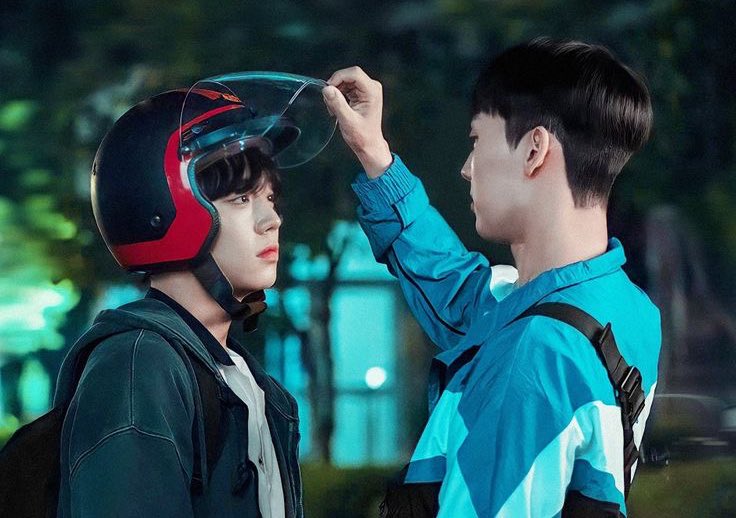
수호와 시은이 관계에 대해 성애적으로도 볼 수 있느냐 그건 보는 뷰어에 따라 다르다고 생각하고 (Whether you can view Su-ho and Si-eun’s relationship in a sexual way depends on the viewer) 어떤 구독자가 만일 수호와 시은에게 시간이 좀 더 있었다면 그렇게 될 수도 있지 않았을까? 라는 코멘트도 있었음 (Some subscriber commented that if Su-ho and Si-eun had more time, maybe it could have developed that way)
🦋 If they had tried to put those boiling emotions into words and definitions, it wouldn’t have been such a heart-fluttering drama.
Why Si-eun’s Breakdown Actually Makes Perfect Sense
Personally, I think critics who question why Si-eun would “go that far for someone he knew for 41 days” are missing something fundamental about how teenagers experience connection. When I watch those scenes, I don’t see 41 days – I see a lifetime of isolation finally ending, and then that lifeline being cut.
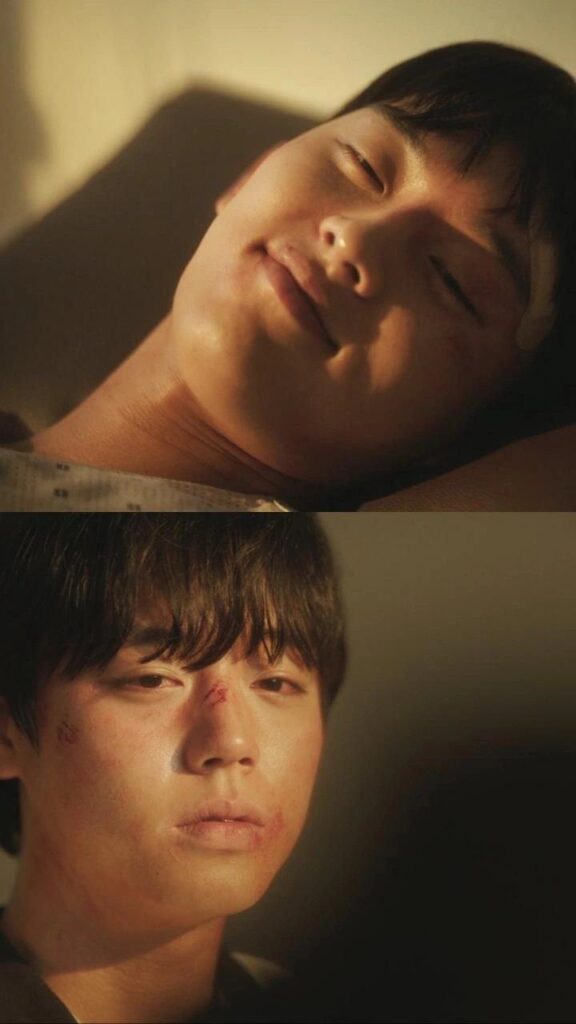
For me, the genius of Weak Hero Class 1 is how it made me completely invest in Su-ho and Si-eun’s relationship. By episode 8, I felt like I’d experienced that friendship through Si-eun’s eyes – I’d seen how it transformed him, gave him hope, showed him what love could feel like. So when that gets ripped away, Si-eun’s breakdown doesn’t feel excessive to me – it feels heartbreakingly human.
제가 보기에 약한영웅 클래스1의 진짜 대단한 점은 수호와 시은이 관계에 완전히 빠져들게 만든 점입니다. 8화까지 보니까 시은이 눈으로 그 우정을 같이 느낀 것 같았습니다 – 그 관계가 시은이를 어떻게 바꿔놨는지, 어떤 희망을 줬는지, 사랑이 뭔지 알게 해줬는지를 다 봤으니까요. 그래서 그게 사라졌을 때 시은이가 무너지는 게 과하다고 느껴지지 않았어요. – 너무나 인간적이어서 마음이 아팠죠.
I keep thinking about that image of little Si-eun doing math problems while his parents fought about regretting having him. For someone whose entire childhood was built around academic hyperfocus just to survive emotional neglect, Su-ho represented something revolutionary – proof that he was worthy of love, that he wasn’t the unwanted burden his parents made him feel like.
Honestly, when I consider Si-eun’s background and possible neurodivergence, his extreme response makes complete psychological sense to me…

I think the connections we form don’t operate on adult timelines – they operate on emotional impact, and by that measure, 41 days of genuine love can feel worth everything.
💭 What do you think about the “41 days” criticism? Have you ever experienced a connection that felt life-changing in a short period of time? Do you think Si-eun’s response was emotionally authentic, even if it wasn’t morally right? Share your thoughts in the comments below!
🔗 Related Content
➡️ Understanding Yeong-i: The Character Who Reveals Everything About Weak Hero’s Heart
Listen to the full podcast episode: Choi Hyun-wook Reveals Behind-the-Scenes Stories About Ahn Su-ho 🎧
🔗 Related Posts by Character & Language
📚 Si-eun (시은) Analysis
English Posts
- Si-eun’s Episode 8 Revenge: Why the “Implausible” Critique Completely Misses the Point
- Why Si-eun is a Character Magnet: The Psychology Behind Weak Hero’s Most Compelling Relationships
- Si-eun’s Hidden Violence: An Exploration
- Si-eun’s Revenge Debate: Core Fan Comments Compilation
🥊 Su-ho (수호) Analysis
English Posts
- Su-ho’s Lost Comedy Gold: The Wordplay That Made Weak Hero Fans Fall in Love (But English Subtitles Missed Everything)
- The Untold Story of Su-ho and Beom-seok: Why Their Friendship Was Doomed from the Start
Korean Posts
💔 Beom-seok (범석) Analysis
English Posts
- When Dreams Become Prison: Analyzing Beom-seok’s Boxing Ring Appearance in Si-eun’s Dreams
- When Subscribers Become Psychology Experts: Two Brilliant Takes on Why Beom-seok Destroyed Su-ho in That Ring
- Beom-seok’s Obsession with Su-ho: The Tragic Psychology Behind Weak Hero’s Most Complex Relationship
⚡ Seong-je (성제) Analysis
English Posts
🤝 Character Dynamics
English Posts
- Su-ho and Si-eun’s Relationship: When Fans Ask the Hard Questions About Weak Hero’s Most Debated Bond
- Understanding Yeong-i: The Character Who Reveals Everything About Weak Hero’s Heart
- Was Yeong-i Added to Tone Down the Bromance? When Subscribers Drop Literary Masterpieces in My Comments
- Jun-tae’s Japanese Mystery and the Heartwarming Go-tak Friendship in Weak Hero Class 2
🎭 Behind-the-Scenes & Analysis
English Posts
- Weak Hero Class 1 Script Book: Behind-the-Scenes Secrets That Will Change How You See the Show
- Script Book vs Final Cut: The Dream Scene That Made Us All Cry
- The Complete Behind-the-Scenes Story of Weak Hero Class 1 – Answering Subscriber Questions
- Weak Hero Class Change Video Explanation: Actors Switching Roles
- Weak Hero Deleted Scene Delivery! Beuksan High’s #1 Taking Down Bullies
🌍 Fan Community & Cultural Analysis
English Posts
- Weak Hero Fans Are Going INSANE and I’m Here for It: The Comments That Broke My Brain
- The Joy of Global Connection: Discussing Weak Hero’s Most Complex Relationships with Fans Around the World
- When International Fans Decode Korean Bromance: Why Weak Hero Reads as BL Overseas
- Three Questions That Reveal Weak Hero’s Hidden Korean Realism
- Why These Three Friends Always Sit Together During Exams (And Other Translation Secrets)
Korean Posts
📊 Quick Navigation by Interest
⚡ Character Dynamics:
- Su-ho and Si-eun’s Relationship
- Beom-seok’s Obsession with Su-ho
- When International Fans Decode Korean Bromance
🧠 Psychology Deep Dives:
- When Subscribers Become Psychology Experts
- Si-eun’s Episode 8 Revenge
- Why Si-eun is a Character Magnet
🎬 Behind-the-Scenes Content:
🌐 Translation & Cultural Context:
⚠️ Site Policies & Legal Information
✅ About JennieKdrama.com: This blog provides personal fan analysis and reviews of K-dramas, focusing on school action series like ‘Weak Hero.’ All content represents individual opinions and interpretations from a fan perspective, unrelated to official production teams.
⛔️ Copyright Disclaimer: All drama footage, images, and references belong to their respective copyright holders including streaming platforms and original creators. Materials are used minimally for educational criticism and analysis with no intention of copyright infringement.
🚫 Privacy Policy: This site follows standard web policies and does not directly collect personal information beyond basic analytics for content improvement. We use cookies to enhance user experience and may display advertisements.
📳 Contact: For questions or concerns, please use the comment sections or contact forms provided. This is fan-created content respecting all original copyrights – we are not responsible for any losses or damages resulting from our content interpretations.